Skip to content

You asked, we listened! We are delighted to announce we are now open late on a Tuesday evening.

Am I in Perimenopause, Menopause or Postmenopause?

Am I in Perimenopause, Menopause or Postmenopause?
One of the most common things women say to me is:

“I don’t even know where I am in all of this.”

You may still be having periods but feel different.
You may have irregular cycles but “normal” blood tests.
You may have stopped bleeding and expected everything to settle, but it hasn’t.

The language around menopause can feel confusing. So let’s make it clearer.

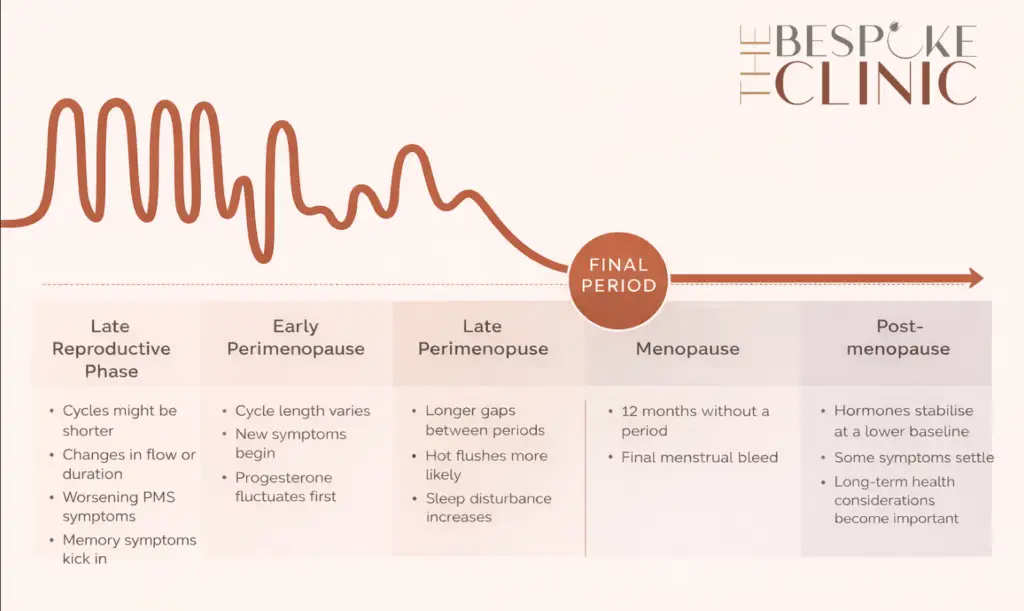
Premenopause

Premenopause refers to the years before hormonal transition begins.
Cycles are generally regular. Ovulation happens consistently. Oestrogen and progesterone rise and fall in a predictable pattern.
That doesn’t mean everything feels perfect. PMS, heavy periods or mood changes can still occur. But the overall hormonal rhythm remains steady. If your cycles are consistent and you feel broadly well, you are likely still in this stage.

Perimenopause

Perimenopause is the transitional phase leading up to menopause. It often begins in the 40s, although some women notice changes in their late 30s. Others continue having periods well into their 50s.

Some women are still having periods at 50 or beyond and worry that something must be wrong. In many cases, this can still fall within the perimenopausal transition.

This is where things start to feel less predictable.

Ovulation becomes less consistent, which means progesterone often declines first. Oestrogen does not simply drop, it fluctuates. Some days it may be high, other days low. Testosterone gradually reduces over time.

That fluctuation is often what drives symptoms.

Sleep becomes lighter. Anxiety rises. Resilience drops. Brain fog appears. Periods change, sometimes heavier, sometimes lighter, sometimes closer together.

Early on, symptoms may feel cyclical. Later, they can become erratic, which in itself can feel stressful.

Blood tests may still sit within “normal” ranges because hormones are fluctuating rather than steadily declining. That is why perimenopause is primarily a clinical diagnosis.

Menopause

Menopause is defined as twelve consecutive months without a period. At this point, ovarian hormone production has declined significantly and oestrogen levels become consistently low.

The turbulence of fluctuation settles, but low hormone levels may bring their own symptoms. Hot flushes, vaginal dryness, sleep disturbance, reduced bone density and metabolic shifts can become more noticeable.

Postmenopause

Postmenopause refers to the years after menopause.

Hormone levels remain consistently low unless hormone therapy is used. Some women feel more stable once the hormonal turbulence of perimenopause ends. Others continue to experience symptoms that affect sleep, mood, cognition or physical health.

At this stage, attention often turns toward longer-term health, bone strength, cardiovascular health, muscle preservation and cognitive resilience.

It is not about chasing youth.
It is about supporting healthy ageing.

Why Does Knowing the Stage Matter?

Understanding where you are helps guide decisions.

Perimenopause may require flexibility. Progesterone support can be particularly relevant. HRT in perimenopause often needs more careful adjustment because hormones are fluctuating rather than consistently low.

Menopause and postmenopause may benefit from steadier oestrogen replacement and a broader focus on long-term health strategy.

The approach is not identical across all stages.

When Should You Seek Support?

If you feel different from yourself, more anxious, more tired, less resilient or less clear-headed, it is reasonable to seek assessment, even if you are still having periods.

You do not need to wait for things to become severe.

Many women seek a private menopause consultation when they feel their symptoms have been minimised or when appointment time has been too limited to explore the full picture.

Hormonal transition rarely follows a textbook timeline.

Personalised Menopause Care

At The Bespoke Clinic, we support women through premenopause, perimenopause, menopause and postmenopause with structured, doctor-led assessment.

If you are looking for a menopause doctor in Newcastle or would prefer an online menopause consultation elsewhere in the UK, appointments are available in clinic and remotely. Investigations can be arranged locally where required, and follow-up is individualised.

If you are unsure which stage you are in, or feel that something has shifted but cannot quite explain it, we would be pleased to support you.

Bioidentical vs Body-Identical HRT

Bioidentical vs Body-Identical HRT

A Balanced View

If you’ve spent time researching menopause treatment online, you will have noticed how divided the conversation can be.
Some clinics dismiss compounded bioidentical hormones entirely. Others promote them as the only safe or “natural” option.
When opinions are that polarised, the truth usually sits somewhere in the middle.
Let’s clarify it properly.

What Do These Terms Actually Mean?

Both body-identical and bioidentical hormones are structurally identical to the hormones your body produces naturally.

The difference is not the molecule. It is the manufacturing and licensing pathway.

Licensed body-identical HRT refers to preparations such as transdermal oestradiol and micronised progesterone that are produced by pharmaceutical manufacturers and hold formal marketing authorisation.

Compounded bioidentical HRT refers to prescriptions prepared individually by specialist compounding pharmacies. These may allow flexibility in dose or combination when clinically required.

Both use pharmaceutical-grade hormones identical to endogenous hormones.

The distinction lies in authorisation and standardisation, not in whether one is “natural” and the other “synthetic.”

What Do Professional Guidelines Say

The British Menopause Society advises that compounded bioidentical HRT is not routinely recommended. Their position reflects:

  • Greater published outcome data for licensed preparations
  • The availability of regulated alternatives
  • Limited evidence supporting routine saliva-based dose adjustment

These are reasonable population-level safety principles. However, guidelines are written for broad application. Clinical medicine is practised with individuals.

Are Compounded Hormones Unregulated?

You may have read that compounded hormones are “unregulated.” That is not accurate.

In the UK, specialist compounding pharmacies are registered with the General Pharmaceutical Council and operate within the Human Medicines Regulations framework. They are inspected and must comply with defined professional and manufacturing standards. The hormones used are pharmaceutical-grade and produced under Good Manufacturing Practice standards.

The key difference is this:

Licensed products undergo large commercial trial programmes tied to marketing authorisation.

Compounded prescriptions are prepared for individual patients and therefore do not follow that commercial licensing pathway.

That distinction matters in terms of evidence hierarchy. It does not mean absence of oversight.

What Does the Evidence Show?

Licensed body-identical oestradiol and micronised progesterone have reassuring safety data and are appropriate for many women.

For compounded formulations, large-scale outcome trials are more limited. That reflects differences in commercial licensing rather than differences in molecular structure.

The pharmacology of oestradiol, progesterone and testosterone is well established. What determines safety in practice is appropriate indication, careful dosing and ongoing review.

Medicine rarely operates in absolutes

When Might Compounding Be Considered?

For many women, licensed body-identical HRT works extremely well and should be first-line.

However, some women:

  • Do not tolerate standard progesterone regimens
  • Require dose adjustments outside available strengths
  • Have persistent symptoms despite optimisation
  • Need combinations not commercially available

In such cases, carefully supervised compounded therapy may be considered.
The key word is supervised.
Compounding should be clinically justified, not trend-driven.

What About Hormone Testing?

A single blood test taken in isolation, such as FSH, taken in isolation, is not a reliable way to decide on hormone replacement requirements
However, broader hormone assessment, when integrated with full clinical evaluation, may offer additional insight in complex cases.
Testing should inform judgement, not replace it.

My Position

I practise within established menopause guidance, including that of the British Menopause Society.

Licensed body-identical preparations are often entirely appropriate and effective.

Where individual circumstances require flexibility, intolerance management or bespoke dosing, compounded bioidentical therapy may be considered within a structured medical framework.

This is not about rejecting pharmaceutical medicine. Nor is it about embracing hype. It is about applying evidence thoughtfully to the individual woman in front of you. Menopause care should be balanced, proportionate and personalised.

If you would like to discuss which approach may be appropriate for you, consultations are available in clinic and remotely across the UK.

Sexual Health and the Menopause

We know there is an impact of hormone reduction during the perimenopause on our physical and psychological health. One aspect of women’s health which is often overlooked, and definitely not talked about enough is the affect it can have on a woman’s libido, vaginal health, and overall sexual satisfaction.

So, what are the challenges?

  • Vaginal Dryness: Declining oestrogen levels during the perimenopause can cause vaginal dryness, making sexual intercourse uncomfortable or painful. This can negatively impact a woman’s sexual desire and overall enjoyment of sexual activities. ‘sandpaper’, ‘cutting inside’ and ‘risk of bleeding’ are some descriptions I have heard in my medical practice.
  • Decreased Libido: Changes in hormone levels can lead to a decrease in sexual desire or a lower libido. Many women report a decline in their interest in sex during the perimenopause, which can be attributed to hormonal fluctuations, physical discomfort, or emotional factors. Women may be more anxious, experience lower mood, along with feeling it is not going to be enjoyable so avoiding the experience of sex altogether.
  • Changes in Orgasm: Some women experience changes in the intensity or frequency of orgasms during menopause. This can also be attributed to hormonal imbalances, reduced blood flow to the pelvic region, or psychological factors such as stress or anxiety.

What can be done to help?

  • Open Communication: Discussing concerns and experiences with a partner is crucial. Open and honest communication can help create a supportive and understanding environment, fostering emotional intimacy and reducing anxiety or stress related to sexual health. It is also important to talk to your doctor or healthcare professional. They can advise you on the best way to manage your symptoms for you as an individual.
  • Vaginal Moisturisers: There are so many on the market, many of which are available over the counter. It is important you chose one which is ‘body-similar’ and does not adversely change the pH of your vagina or the microbiome of your vagina (yes that is a thing!) Ask Dr Neet for advice on this, as there are some fantastic ones around which can really help with daily comfort and sexual intimacy without using any hormones.
  • Vaginal Oestrogen: Whether you are on regular HRT or not, vaginal oestrogen can really help genitourinary symptoms, such as vulval itching, soreness, pain on sex, frequency of urine, feeling of recurrent urine infections. It comes in various forms, such as creams, pessaries, and even a small oestrogen ‘ring’ like a hair bobble which can last 3months! These are prescription only and there are some contraindications, so again speak to Dr Neet about the possibility of using this.
  • The Emsella Chair: Strengthening the pelvic floor muscles through exercises like Kegels can improve vaginal tone and increase sexual satisfaction. However, did you know that most people can only engage around 30% of the muscle fibres in our pelvic floor, if done perfectly, with physio help and with a pelvic floor tool to help. The Emsella Chair delivers almost 12,000 kegels, engaging 100% of the pelvic floor muscle, over just 28 minutes! Sexual health and orgasms have been proven to improve in many women when the right protocol has been used. Ask at reception and get booked in! (this also can help with incontinence problems which can of course have an impact on our sexual health too)
  • The Exilis Ultra Femme 360: This is a revolutionary, non surgical vaginal rejuvenation device and only takes 8minutes. It stimulates blood flow and collagen production targeting vaginal laxity (looseness) and can also be used externally for labial remodelling. Female sexual satisfaction has been proven to improve and this can only be a good thing!
  • Regular Physical Activity: Engaging in regular exercise has numerous benefits for overall health, including sexual health. Exercise increases blood flow, boosts mood, reduces stress, and improves self-esteem, all of which can positively influence sexual well-being. The Bespoke Clinic runs one to one Personal training sessions and small group work, and the aims of these sessions will be led by you.

Take home message

The perimenopause is an expected but challenging phase in a woman’s life, and sexual health deserves attention and care during this time. By understanding the challenges and being proactive in managing sexual health concerns, women can maintain a fulfilling and satisfying sex life well into their postmenopausal years. Open communication, seeking professional guidance when needed, and incorporating self-care practices can help navigate the changes and embrace this new chapter with confidence and vitality. Remember, sexual health is an essential aspect of overall well-being, and taking care of it is an empowering choice every woman deserves to make.

Make an appointment for a confidential and thorough consultation.

Be Sexual


P.S. Don’t forget about the risk of sexually transmitted infections. Any change in partner at any age can be a risk, and there is an increase in the prevalence of STIs in the over 50s now, so be safe and get checked if in doubt!


Exercise & Menopause

The importance of exercise

When people ask if they exercise there can be such a variety of responses- understandably! These include:

  • ‘No, I don’t have any time’
  • ‘Yes, I am on my feet all day’
  • ‘I go swimming twice a week’
  • ‘I walk the dog twice a day’
  • ‘I cycle to and from work’
  • ‘I am a member of a gym and sometimes go to classes’

The most important type of exercise women can do, in my opinion, is strength-based exercises and the reason for this is that women are at a much higher risk of developing osteoporosis. As we go through the ages, our oestrogen levels drop and this has an impact on bone density and structure. It happens at a much higher rate than seen in men. There are additional risk factors as well, such as smoking or excessive alcohol intake, extremely low body weight, poor nutrition, some autoimmune and endocrine conditions, and long term oral steroid use.

By doing some strength-based exercises not only during the perimenopause, but throughout our lives, we can improve our bone density and reduce our risks going forwards.

And this is not about getting massive or entering a bikini body competition ladies! This is about getting stronger, fitter, improving mobility and being more functional in our day to day lives.

Strength based exercises can be done by using our own body weight or using dumbbells and Olympic bars. Whatever your ability, (or lack of) the Personal Trainers at The Bespoke Clinic will help you develop your strength, improve your confidence in moving and lifting and help reduce your risks of age related and hormone linked conditions like osteoporosis, metabolic syndrome, cardiovascular disease. You will see results and be motivated to keep it going!

Other benefits of exercising in general are:

  1. Hormonal regulation: Regular exercise can help regulate hormones and mitigate some of the symptoms associated with menopause, such as hot flushes, mood swings, and sleep disturbances.
  2. Weight management: Menopause often leads to weight gain, particularly around the abdomen. Regular exercise, including aerobic activities and strength training, can help control weight by boosting metabolism and maintaining muscle mass, which tends to decrease with age.
  3. Cardiovascular health: As oestrogen levels decline, women become more susceptible to cardiovascular disease. Exercise improves cardiovascular health by lowering blood pressure, improving cholesterol profiles, reducing the risk of heart disease, and enhancing overall cardiovascular function.
  4. Mental well-being: Menopause is often accompanied by mood swings, anxiety, and depression. Exercise stimulates the release of endorphins, which are natural mood-enhancing chemicals, leading to improved mental well-being and reduced symptoms of depression and anxiety.
  5. Sleep quality: Many women experience disrupted sleep patterns during menopause. Regular exercise has been shown to improve sleep quality and duration, helping women get better rest and reducing sleep disturbances.
  6. Cognitive function: Hormonal changes during menopause can also affect cognitive function and increase the risk of cognitive decline. Exercise has been associated with improved cognitive function, including enhanced memory, attention, and overall brain health.

Make an appointment with one of our amazing personal trainers who can help you continue or even start your journey. Izzy is also trained in Nutrition and Josie is a Yoga Teacher. Tap into their expertise so we can look after the whole of you.

Be strong 


Back To Top